


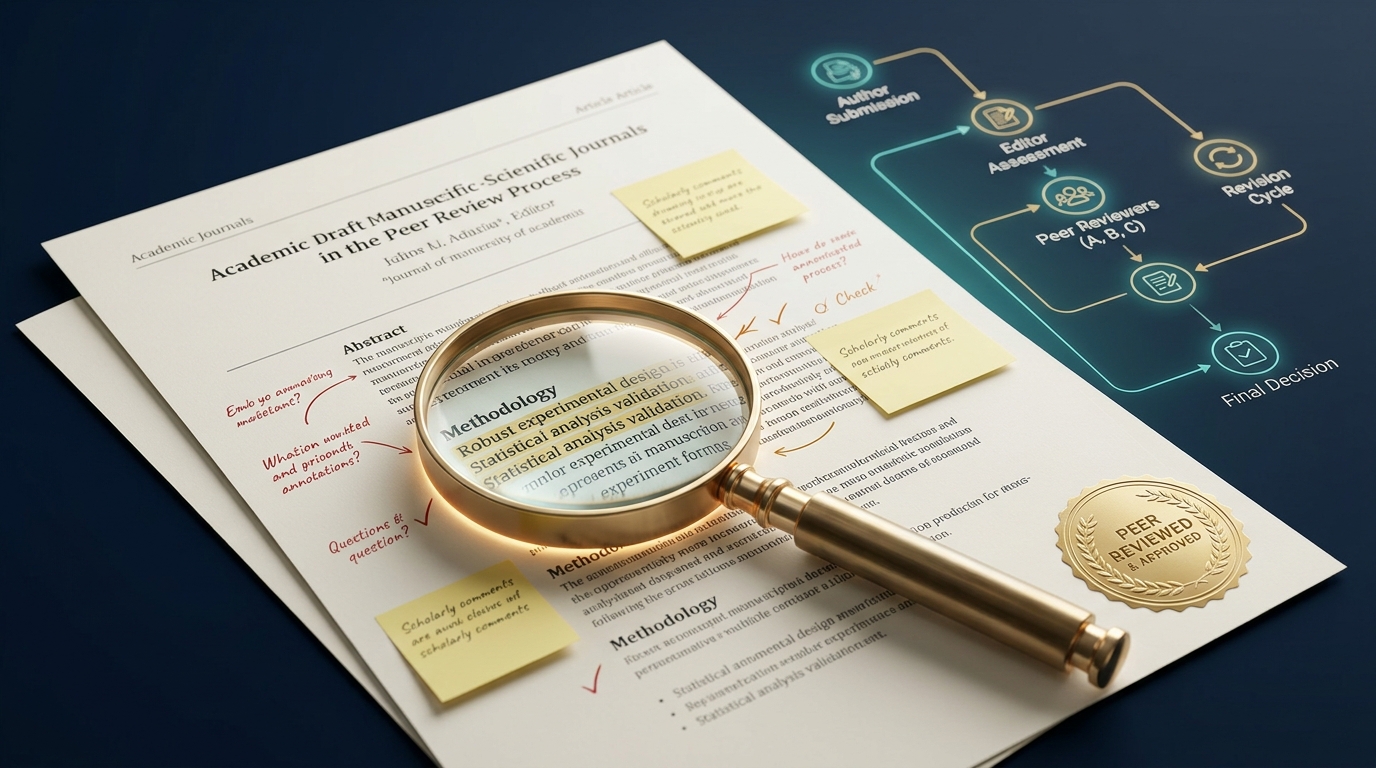
For first-time authors, hitting the "Submit Manuscript" button in an online editorial system is often accompanied by an exhilarating rush of relief—quickly replaced by a paralyzing mystery. Where does your paper go? Who actually reads it? How are decisions made? And why does the process often take weeks or months? Understanding the mechanics of scientific peer review transforms what can feel like an intimidating trial into an empowering, collaborative partnership that sharpens your scholarship.
Peer review is not an obstacle course designed to keep young researchers out; it is the quality assurance mechanism of the scientific record. Every major medical breakthrough, aerospace innovation, and computational milestone has passed through this critical filter. Here is an inside look at how the process functions and how you can master it.
The Editorial Workflow: From Submission to Decision
Once submitted, a manuscript embarks on a structured multi-stage evaluation:
1. Initial Editorial Desk Screening
Before any independent reviewer sees your paper, the Editor-in-Chief or an Associate Editor conducts a preliminary screening known as the desk review. During this stage, editors assess three core criteria:
- Aims and Scope: Does this manuscript match the specific scientific domains covered by the journal?
- Baseline Technical Rigor: Are the methods adequately described? Are control groups and statistical analyses present?
- Formatting and Ethical Compliance: Has the author adhered to word counts, citation guidelines, figure formatting, and institutional ethical clearances (e.g., human subject protections or animal research protocols)?
A "desk rejection" occurs when a paper fails one of these foundational benchmarks. It is not necessarily a reflection of the science's value, but rather an administrative determination that the manuscript is not suitable for that specific venue.
2. Assignment to External Peer Reviewers
If your manuscript clears desk screening, the editor invites two to four subject-matter experts—independent researchers active in the same specialized field—to conduct an in-depth technical critique. Reviewers volunteer their time to scrutinize the experimental design, mathematical proofs, software pipelines, and logical conclusions.
The Different Peer Review Models
Journals employ several distinct models of peer review, each with specific privacy conventions:
- Single-Blind Review: The reviewers know the authors' names and institutions, but the authors do not know the reviewers' identities. This remains the most common model across physical and life sciences.
- Double-Blind Review: Neither the authors nor the reviewers know each other's identities. This model helps mitigate implicit biases related to author age, prestige of institution, geographic origin, or gender.
- Open Peer Review: Both author and reviewer identities are public, and reviewer reports may be published alongside the accepted manuscript. This fosters radical transparency and constructive discourse.
"Reviewer feedback is free, world-class consulting from experts who have dedicated hours of their lives to examining your thinking. Treat every critique as an opportunity to elevate your paper."
What Do Peer Reviewers Actually Look For?
Reviewers generally structure their evaluation reports around several key dimensions:
- Novelty and Significance: Does the study advance scientific knowledge beyond what is already published? Does it provide new empirical data, an improved analytical framework, or novel biological insights?
- Methodological Validity: Are experimental protocols appropriate for the questions asked? Were variables adequately controlled? Are statistical tests valid and properly applied?
- Data Integrity and Reproducibility: Are raw data, figures, and code sufficiently detailed to allow independent replication?
- Clarity and Scholarly Tone: Is the prose precise, objective, and well-organized? Are claims proportionate to the evidence provided, or do authors over-generalize their findings?
Understanding Decision Categories
After reviewing the referee reports, the handling editor renders one of four standard editorial decisions:
- Accept Without Revision: Extremely rare in modern scholarly publishing (occurring in less than 2% of initial submissions).
- Minor Revision: The core scientific conclusions are sound, but the authors must address minor textual clarifications, improve figure resolution, or expand literature citations.
- Major Revision: The manuscript has substantial promise, but significant questions remain. Authors may need to perform supplementary analyses, re-evaluate statistical assumptions, or restructure their discussion before the paper can be reconsidered.
- Reject: The study exhibits fundamental methodological flaws, lacks sufficient novelty, or lies outside the journal's mission. While disappointing, rejection is an everyday reality in professional science—even Nobel laureates experience frequent rejections.
The Golden Rules for Writing a "Response to Reviewers"
When you receive a revision request, your accompanying Response to Reviewers letter is just as important as the revised manuscript itself. Follow these proven principles:
- Be Respectful and Professional: Begin by sincerely thanking the editor and reviewers for their constructive insights. Never respond while defensive or frustrated.
- Adopt a Point-by-Point Format: Copy every single reviewer comment verbatim in bold, followed immediately by your detailed response and the exact line numbers in the revised manuscript where modifications were made.
- Disagreeing Respectfully with Empirical Evidence: You do not have to agree with every reviewer suggestion. If a reviewer misunderstands a method or requests an out-of-scope experiment, politely explain your perspective supported by citations to established literature or additional baseline data.
Conclusion
The peer review process is the bedrock of scientific credibility. When young researchers view peer review not as an intimidating test to be survived, but as an apprenticeship in intellectual rigor, their papers become stronger, their scientific reasoning becomes sharper, and their contributions to the global knowledge commons endure.

0 Comments